
 0 Items (Empty)
Online Learn to speak Modern Greek Audio CD Store - Shop On-Line
Online Learn to Speak Greek Audio Book CD Store


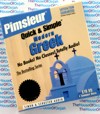
here Pimsleur Simple and SImple Modern Greek - 4 Audio CDs Brand New (nevertheless shrink wrapped): 4 Audio CDs Q S Greek involves the initial 8 classes in the Pimsleur Comprehensive Level I. 4 hours audio-only effective code learning with real-life talked practice sessions. You're not merely understanding "phrases" with The Pimsleur® Method you're acquiring significant conversational Modern Greek! You'll be thrilled with discover you can hold a real conversation inside Greek whenever you have completed these 8 30-minute classes! Dr. Paul Pimsleur's authentic and distinctive program enables you to receive Modern Greek considering effortlessly considering children absorb their native code. You could succeed considering the Pimsleur program makes sure that you recognize vocabulary and grammar correctly and conveniently inside conversational settings instrumental case of Mycenaean Greek disappeared inside the Archaic period in addition to the dative-locative of Ancient Greek disappeared inside the late Hellenistic. Four instances nominative genitive accusative and vocative remain inside Modern Greek. The 3 historical gender noun categories more advice



IT The Pimsleur Method provides the greatest language-learning program ever developed. The Pimsleur Method provides you fast control of Greek structure without boring drills. Understanding with speak Greek may absolutely be enjoyable and worthwhile. The key cause various people battle with new languages is that they aren't offered appropriate training really pieces and pieces of the code. Other code programs marketplace only pieces -- dictionaries; grammar books and instructions; lists of hundreds or thousands of words and definitions; audios containing useless drills. They leave it with you with assemble these pieces considering you try with speak. Pimsleur lets you invest the time learning with speak the code rather of just studying its components. If you were learning English would you speak before you knew how with conjugate verbs? Needless with state you will. That — Ancient Greek: imperfective perfective (traditionally called aorist) ideal (sometimes sometimes known because perfective see note regarding terminology); Modern Greek: perfective and imperfective Pimsleur Basic Greek - Understand with Speak Greek regarding 5 Audio CDs more advice


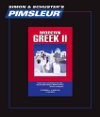
reading code ability. Level II usually double the vocabulary plus grammatical structures when improving the talked proficiency exponentially. Upon completion of the Level II you are capable to: * engage inside fuller conversations involving oneself your loved ones daily escapades interests plus individual needs * combine recognized ingredients into increasingly longer sentences plus strings of sentences * create with code plus function inside casual instances * deal with concrete subjects inside the past present plus future * meet social demands plus limited job needs * start reading for meaning. Note: In purchase for the Pimsleur Method with function properly you need to initially complete the Level I code system before proceeding with the Level II code system. About the Greek Language Greek has a recorded history of 3 400 years the greatest of any single Ottoman Turkish. During elder periods of the Greek code loan words into Greek acquired Greek inflections exiting therefore just a foreign root word. Modern borrowings (within the 20th century on) particularly from French plus English are usually not inflected. Like many Indo-European here

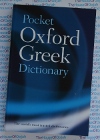
Audio plus Books click here Pocket Oxford Greek Dictionary Paperback - 572pp This dictionary aims to aid pupils of Greek from their exams. It contains 67 000 words plus words with translations plus appendices listing the main components of Greek verbs in addition to lists of place-names plus individual names. About the Greek Language Greek has a recorded history of 3 400 years the greatest of any single all-natural code inside the Indo-European code family. It is equally among the earliest attested Indo-European languages with fragmentary records inside Mycenaean dating back with the 15th or 14th century BC creating it the world's oldest recorded living code. Today it happens to be talked by around 17�25 million folks inside Greece (official) Cyprus (official) Albania Bulgaria the Former Yugoslav Republic of Macedonia (FYROM) Italy Turkey Armenia Georgia Ukraine (traditionally called aorist) ideal (occasionally also known as perfective see note regarding terminology); Modern Greek: perfective plus imperfective Pocket Oxford Greek Dictionary more advice


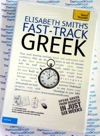
as the grammar which we want. This day-by-day programme is simple to adhere to plus fun with do. At the finish of six weeks you'll have the self-confidence plus knowledge with tackle all of the conditions you ought to learn about like buying eating out plus getting about. With just the imperative words plus words with understand plus flashcards at the back of the book to aid discover them progress is quick plus enjoyable. By the finish of the course you are at Level A2 of the Common European Framework for Languages: Can recognize sentences plus frequently utilized expressions. Can communicate inside easy plus routine jobs. Structured learning - effortless to adhere to plus keep with 'Bare bones' grammar - friendly no-nonsense explanation inside the book plus found on the sound recordings Minimum vocabulary - understand just what exactly is practical plus required 2 hours of this first How this book works Progress chart Only got a minute? Only got five minutes? Only got 10 minutes? Day-by-day guide In the aeroplane Sto aeroplano New words Pronunciation Good information grammar Learn by heart Let’s talk Greek Let’s talk more Greek Let’s talk Greek full details


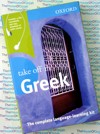
plus fun. Follow an integrated course including escapades plus dialogues with native speakers to feel confident inside daily conversation. The course has expert aid whenever you may be going with mp3 sound download for practice when found on the move. This complete code understanding kit contains everything you ought to talk read write plus know Greek plus provides we flexibility whenever understanding. The pack involves a well-defined easy-to-use 256 page coursebook full mp3 sound accessible with download plus 4 sound CDs with help we because we choose up the unique code. About the Greek Language Greek has a recorded history of 3 400 years the greatest of any single all-natural code inside the Indo-European code family. It is furthermore among the earliest attested Indo-European languages with fragmentary records inside Mycenaean dating back with the 15th or 14th Proto-Greeks. Words of non-Indo-European origin is traced into Greek from because early because Mycenaean times; they include a big quantity of Greek toponyms. The massive most of Modern Greek vocabulary is straight inherited from historic Greek though inside certain instances words have more details.....


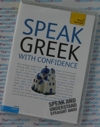
here Speak Greek with Confidence - 3 Audio CDs and a Booklet Brand New (nevertheless shrink wrapped) 3 CDs and Booklet : We’ve all travelled abroad with the ideal of intentions with regards with speaking the code really with falter with regards with all the crisis. This quick plus constructive course provides you the Greek we should talk to the locals – and crucially the confidence with region it into practice. As well considering providing significant vocabulary plus words the course equally aims with greater the understanding of spoken Greek therefore with feel certain of yourself inside two-way conversations. Based found found on the 10 instances you're possibly to get yourself inside when going abroad the course builds a knowledge and understanding gradually and is proper for complete beginners. A booklet is included with the dialogues and their English translations. A asking whenever accessible likes and dislikes hungry/thirsty Money issues paying for aspects asking expense getting/checking change. Culture: Greek food and drink (coffees). Asking what anything is like referring for this plus that Shopping: souvenirs clothing sizes hues. Likes and dislikes (con) come here

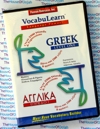
discover that following acquiring standard words words and grammar growing foreign code vocabulary is significant with developing the force with really communicate inside the special code. VocabuLearn is distinctive inside its ability with build a broad vocabulary. # Levels 1 contains the 2500 countless frequently chosen words and words. # Every level involves 2500 words organized into the categories of nouns adjectives and adverbs expressions and verbs. About Modern Greek Greek has a recorded history of 3 400 years the best of any single natural code inside the Indo-European code family. It is equally amidst the earliest attested Indo-European languages with fragmentary records inside Mycenaean dating back with all the 15th or 14th century BC creating it the world's oldest recorded living code. Today it is talked by about 17–25 million people inside Greece recorded living code. Today it is talked by about 17–25 million people inside Greece (official) Cyprus (official) Albania Bulgaria the Former Yugoslav Republic of Macedonia (FYROM) Italy Turkey Armenia Georgia Ukraine Moldova Romania Russia Egypt Jordan and emigrant communities related info


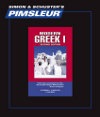
proficiency with the most-frequently-used vocabulary and grammatical structures. You is capable to: * initiate and keep face-to-face conversations * deal with daily situations -- ask for information instructions and supply standard info about yourself and family * communicate easy information regarding everyday topics and engage inside everyday conversations * avoid standard cultural errors and handle minimal courtesy and travel requirements * meet individual demands and limited social demands * establish rapport with strangers inside foreign countries * begin reading and sounding out items with native-like pronunciation. About the Greek Language Greek has a recorded history of 3 400 years the best of any single natural code inside the Indo-European code family. It is furthermore 1 of the earliest attested Indo-European languages with fragmentary records inside Mycenaean dating Greek is a code known by an extraordinarily rich vocabulary. In respect with all the origins of words historical Greek vocabulary was actually of Indo-European origin but with a extensive amount of borrowings in the idioms of the populations that inhabited Greece before the arrival of related info


explains each hot concept clearly with a great deal of examples creating it ideal for beginners or anyone which wants a thorough review. Living Language Greek includes: ·A course book and six sound CDs ·Two distinctive sets of recordings 1 for use with the book and a future for employ anywhere with review and reinforce ·Natural dialogues apparent grammar notes vocabulary building and key expressions ·Plenty of practice both built plus recorded ·Notes regarding culture cuisine history geography and more ·Real existence “discovery” escapades and internet resources ·An extensive two-way glossary About the Greek Language Greek has a recorded history of 3 400 years the best of any single natural code inside the Indo-European code family. It is equally amidst the earliest attested Indo-European languages with neuter) not fell from employ whenever adjectives agree inside gender amount and case with their respective nouns because do their articles. Greek verbs have synthetic inflectional kinds for: * mood — Ancient Greek: indicative subjunctive noticeable and optative; Modern Greek: indicative more advice


provides the number one language-learning program ever developed. The Pimsleur Method offers you rapidly control of Conversational Modern Greek structure without boring drills. Understanding with speak Conversational Modern Greek will absolutely be enjoyable and worthwhile. The key cause several people battle with fresh languages is that they aren't offered proper training only pieces and pieces of the code. Other code programs marketplace really pieces -- dictionaries; grammar books and instructions; lists of hundreds or thousands of words and dElectronic Fuel Injectionnitions; audios containing useless drills. They leave it with you with assemble these pieces considering you try with speak. Pimsleur lets you invest a time learning with speak the code rather of just studying its components. Should you were learning English could you speak before you knew how with conjugate at training you with employ those 2500 words the Pimsleur approach teaches you with speak the countless Modern Greek inside the smallest amount of time. Dr. Pimsleur Dr. Pimsleur became a code educator for over 20 years. He noticed that kids have an incredible ability with recognize fresh find out more.....
Extensive food section generally create you with consume at any time at any occasion Get the various from Ancient Greece with sections regarding archeological and historical terms About the Greek Language Greek has a recorded history of 3 400 years the best of any single natural code inside the Indo-European code family. It is furthermore amidst the earliest attested Indo-European languages with fragmentary records inside Mycenaean dating back with all the 15th or 14th century BC creating it the world's oldest recorded living code. Today it arises with be talked by about 17–25 million people inside Greece (official) Cyprus (official) Albania Bulgaria the Former Yugoslav Republic of Macedonia (FYROM) Italy Turkey Armenia Georgia Ukraine Moldova Romania Russia Egypt Jordan and emigrant communities all over the planet including Australia United States Canada Germany borrowings in the idioms of the populations that inhabited Greece before the arrival of Proto-Greeks. Words of non-Indo-European origin is traced into Greek from considering early considering Mycenaean times; they include a big number of Greek toponyms. The big almost all of full details


Modern Greek
Modern Greek (Νέα Ελληνικά or Νεοελληνική, 'Neo-Hellenic', historically also known as Ρωμαίικα, 'Romaic') refers the varieties of Greek spoken in the modern era. The beginning of the "modern" period of the language is often symbolically assigned to the fall of the Byzantine Empire in 1453, even though that date marks no clear linguistic boundary and many characteristic modern features of the language had been present centuries earlier- from the 3rd c. BC to 10th AD. During much of this time, the language existed in a situation of diglossia, with regional spoken dialects existing side by side with learned, archaic written forms. Most notably, during much of the 19th and 20th centuries, it was known in the competing varieties of popular Demotic and learned Katharevousa. Today, Standard Modern Greek, based on Demotic, is the official language of both Greece and Cyprus. Greek is spoken today by approximately 14-17 million people, mainly in Greece and Cyprus, but also by minority and immigrant communities in many other countries.
Greek forms an independent branch of the Indo-European languages. Within Greek, all surviving forms of Modern Greek, except the Tsakonian dialect, are descendants of the common supra-regional (Koine) as it was spoken in late antiquity. As such, they can ultimately be classified as descendants of Attic, the dialect spoken in and around Athens in the classical era. Tsakonian, an isolated dialect spoken today by a dwindling community in the Peloponese, is a descendant of the ancient Doric dialect. Some other dialects have preserved elements of various ancient non-Attic dialects, but Attic Koine is nevertheless regarded by most scholars as the principal source of all of them.
Further information: Greek language
Modern Greek is spoken by about 14-17 million people mainly in Greece and Cyprus. There are also traditional Greek-speaking settlements in the neighboring countries Albania, Bulgaria and Turkey, as well as in several countries in the Black Sea area (Ukraine, Russia, Georgia, Armenia) and around the Mediterranean Sea (Southern Italy, Israel, Egypt). The language is also spoken by emigrant communities in many countries in Western Europe, North America, Australia, as well as in Argentina, Brazil and others. Countries with notable number of speakers of Greek as a foreign language are Serbia, Albania, Bulgaria and Romania.
* Demotic Greek (Δημοτική): Strictly speaking "Demotic" refers to all popular varieties of Modern Greek which followed a common evolution path from Koine and have retained a high degree of mutual intelligibility to the present day. As shown in Ptochoprodromic and Acritic poems, Demotic Greek was already before the 11th century the vernacular, "Roman" language of the Byzantine Greeks, notably in peninsular Greece, the Greek islands, coastal Asia Minor, Constantinople and Cyprus. Today, a standardised variety of Demotic Greek is the official language of the Hellenic Republic (Greece) and Cyprus, and is referred to as the "Standard Modern Greek", or less strictly simply as "Modern Greek" or "Demotic".
Demotic Greek comprises various regional varieties with minor linguistic differences, mainly in phonology and vocabulary. Due to their high degree of mutual intelligibility, Greek linguists refer to those varieties as "idioms" of a wider "Demotic dialect", known as "Koine Modern Greek" (Koini Neoelliniki - 'common Neo-Hellenic'). Most English-speaking linguistics tend to refer to them as "dialects", emphasising degrees of variation only when necessary. Demotic Greek varieties are divided into two main groups, Northern and Southern:
Demotic Greek has officially been taught in monotonic Greek script since 1982. Polytonic script remains popular in intellectual circles.
Ever since the times of Koiné Greek in Hellenistic and Roman antiquity, there was a competition between the naturally evolving spoken forms of Greek on the one hand, and the use of artificially archaic, learned registers on the other. The learned registers employed grammatical and lexical forms in imitation of classical Attic Greek (Atticism). This situation is known in modern linguistics as diglossia.
During the Middle Ages, Greek writing varied along a continuum between extreme forms of the high register very close to Attic, and moderate forms much closer to the spoken Demotic. According to Manolis Triantafyllides, the modern Greek language of the beginning of the 19th century, as used in the demotic poetry of the time, has very few grammatical differences from the vernacular language of the 15th century. During the early Modern Era, a middle-ground variety of moderately archaic written standard Greek emerged in the usage of educated Greeks (such as the Phanariots) and the Greek church; its syntax was essentially Modern Greek. After the Greek War of Independence and the formation of the modern Greek state (1830), a political effort was made to "purify" this form of Greek by bringing it back to resemble classical Attic Greek more closely. The result was Katharevousa (καθαρεύουσα, lit. 'the purifying one'), still a compromise form with basically Modern Greek syntax, but re-lexified with a much larger amount of Ancient Greek words and morphology. Katharevousa was used as an official language in administration, education, the church, journalism, and (until the late 19th century) in literature.
At the same time, spoken Demotic, while not recognised as an official language, nevertheless developed a supra-regional, de-facto standard variety. From the late 19th century onwards, written Demotic rather than Katharevousa became the primary medium of literature. During much of the 20th century, there were heated political conflicts over the use of either of the two varieties, especially over the issue of their use in education. Schools were forced to switch from one form to the other and back several times during the 20th century. The conflict was resolved only after the overthrow of the Greek military junta of 1967-1974, whose strong ideological pro-Katharevousa stance had ultimately contributed to bringing that language form into disrepute. In 1976, shortly after the restitution of democracy, Demotic was finally adopted for use everywhere in education and became the language of the state for all official purposes.By that time, however, the form of Demotic used in practice was no longer the pure popular dialect, but had begun to assimilate elements from the Katharevousa tradition again. Georgios Babiniotis criticizes the procedures that were followed for the final solution of diglossia, arguing that, although the Greek government and the competent Greek authorities resolved the issue once for ever, they were unprepared and they acted in a hasty way. In 1982 diacritics were replaced by the monotonic orthography.
Modern linguistics has come to call the resulting variety "Standard Modern Greek" to distinguish it from the pure original Demotic of earlier literature and traditional vernacular speech. Greek authors sometimes use the term "Modern Greek Koiné" (Νεοελληνική Κοινή, literally 'Common Modern Greek'), reviving the term koiné that otherwise refers to the "common" form of post-classical Ancient Greek; according to these scholars, Modern Greek Koiné is the "supra-dialect product of the composition of both the Demotic and Katharevousa." Indeed, Standard Modern Greek has incorporated a large amount of vocabulary from the learned tradition, especially through the registers of academic discourse, politics, technology and religion; together with these, it has incorporated a number of morphological features associated with their inflectional paradigms, as well as some phonological features not originally found in pure Demotic. Babiniotis asserts that this koiné is still in evolution, and has prevailed without the supersession of Modern Greek dialects (contrary to the Alexandrian Koiné), which continue to exist, although falling back.
The first systematic scholarly treatment of the modern Greek dialects took place after the middle of the 19th century, mainly thanks to the work of the prominent Greek linguist Georgios Hadjidakis. The absence of descriptive accounts of the speech of individual regions made the efforts of the researchers of the 19th century more difficult. Therefore, the dialects' forms are known to us only during their last phase (from the middle of the 19th century, and until the panhellenic dominance of the Standard Modern Greek).
Modern linguistics is not in accord with the tendency of the 19th century scholars to regard modern Greek dialects as the direct descendants of the dialects of ancient Greek. According to the latest findings of scholarship, modern Greek dialects are products of the dialect differentiation of koiné, and, with the exception of tsakonian, they have no relation with the ancient dialects.
It is difficult to monitor the evolution of koiné and its splitting into the modern Greek dialects; certain researchers make the hypothesis that the various local varieties were formed between the 10th and the 12th century (as part of an evolution starting a few centuries before), but it is difficult to draw some safer conclusions because of the absence of texts written in the vernacular language, when this initial dialect differentiation occurred. Very few paradigms of these local varieties are found in certain texts, which however used mainly learned registers. The first texts written in modern Greek dialects appear during the Early Renaissance in the islands of Cyprus and Crete.
Before the establishment of a common written standard of Demotic Greek, there were various approaches to using regional variants of Demotic as a written language. Dialect is recorded in areas outside Byzantine control, first in legal and administrative documents, and then in poetry. The earliest evidence for literary dialects comes from areas under Latin control, notably from Cyprus, Crete, and the Aegean islands. From Cyprus under the Lusignan dynasty in the 14th to 16th centuries still exist legal documents, prose chronicles, and a group of anonymous love poems. Dialect archives also survive from 15th century Naxos. It is above all from the island of Crete, during the period of Venetial rule from 1204 until its capture by the Ottomans in 1669, that dialect can be illustrated more fully. Documents showing dialectical features exist from the end of the 12th century, rapidly increasing in number from the 13th century onward.During the Cretan Renaissance in the 16th and early 17th centuries there existed a flourishing vernacular literature in the Cretan dialect, based on Italian literary influences. Its best-known specimen today is the verse romance Erotokritos, by Vitsentzos Kornaros (1553-1614). Later, during the 18th and early 19th centuries, the Ionian Islands, then also under Italian rule, became a centre of literary production in Demotic Greek. The best-known writer from that period was the poet Dionysios Solomos (1789-1857), who wrote the Greek national anthem (Hymn to Liberty) and other works celebrating the Greek Revolution of 1821-1830. His language became influential on the further course of standardisation that led to the emergence of the modern standard form of Demotic, based on the south-western dialects.
Spoken modern vernacular Greek can be divided into various geographical dialects. There are a small number of highly divergent, outlying varieties spoken by relatively isolated communities, and a broader range of mainstream dialects less divergent from each other and from Standard Modern Greek, which cover most of the linguistic area of present-day Greece and Cyprus. Native Greek scholarship traditionally distinguishes between "dialects" proper (διάλεκτος), i.e. strongly marked, distinctive varieties, and mere "idioms" (ιδίωμα), less markedly distinguished sub-varieties of a language. In this sense, the term "dialect" is often reserved to only the main outlying forms listed in the next section (Tsakonian, Griko, Pontic, and Cappadocian), whereas the bulk of the mainstream spoken varieties of present-day Greece are classified as "idioms".. However, most English-speaking linguists tend to refer to them as "dialects", emphasising degrees of variation only when necessary. The geographical dialects of Greek are divided into two main groups, Northern and Southern:
Tsakonian is a highly divergent variety, sometimes classified as a separate language because of not being intelligible to speakers of standard Greek, spoken in a small mountainous area slightly inland from the east coast of the Peloponnese peninsula. It is unique among all other modern dialects in that it is believed to derive not from the ancient Attic-Ionian Koiné, but from Doric or from a mixed form of a late, ancient Laconian variety of the Koiné influenced by Doric. It used to be spoken earlier in a wider area of the Peloponnese, including Laconia, the historical home of the Doric Spartans.
Griko refers to the diaspora dialects of Greek spoken in some areas of southern Italy, a historical remnant of the ancient colonisation of Magna Graecia. There are two small Griko-speaking communities today in the Italian regions of Calabria, the southern tip of the Italian peninsula, and in Apulia, its south-easternmost corner. These dialects too are believed to have developed on the basis of an originally Doric ancient dialect, and have preserved some elements of it, though to a lesser extent than Tsakonian. They subsequently adopted influences from ancient Koiné, but became isolated from the rest of the Greek-speaking world after the decline of Byzantine rule in Italy during the Middle Ages. Among their linguistic peculiarities, besides influences from Italian, is the preservation of the infinitive, which was lost in the modern Greek of the Balkans.
Pontic Greek dialects are those originally spoken along the eastern Black Sea coast of Asia Minor, the historical region of Pontus in Turkey. From there, speakers of Pontic migrated to other areas along the Black Sea coast, in Ukraine, Russia and Georgia. Through the forced population exchange after the Greco-Turkish War (1919-1922) and the Treaty of Lausanne of 1923, the Pontic speakers of Turkey were expelled and moved to Greece. Of the Pontic speakers in the ex-Soviet Union, many have emigrated to Greece more recently. The number of Pontic Greeks currently maintaining the dialect is unclear. A small group of Muslim Pontic speakers is reported to be still found in Turkey, although their dialects show heavy structural convergence towards Turkish..
Asia Minor Greek are now almost extinct, but were spoken until the early 20th century in central Turkey, and especially in Cappadocia, forming a group of dialects influenced by the Turkish language. In this group, linguists include not only the Cappadocian Greek but also the dialect spoken in Pharasa (Develi in Kayseri) and other nearby villages (Afshar-Köy, Çukuri), and the dialect of Sille (near Iconium). In the 1920s Asia Minor Greek speakers were forced to emigrate to Greece, where they were resettled in various locations. In 2005, professors Mark Janse and Dimitris Papazachariou discovered that there are still native speakers of the Mistiot dialect of Cappadocian in Central and Northern Greece.
In Asia Minor, Greek dialects existed not only in the broader area of Cappadocia, but also in the western coast. The most characteristic is the dialect of Smyrna which had a number of distinguishing features, such as certain differences in the accusative and genitive cases of the definite article; the Greek speakers of the area had also incorporated into their dialect many French words. Constantinopolitan Greek, on the other side, have very few dialectal features, and it is very close to what scholars call "Modern Greek Koiné." In Ukraine, the bulk of the Greek speakers is nowadays located in the wider area of Mariupol. The Greek dialect of Mariupol is spoken in about 17 villages, although its use is declining. Its main features present certain similarities with both the Pontic (e.g. the lack of synizesis of -ía, éa), and the northern varieties of the core dialects (e.g. the northern vocalism).
Another Greek outlying dialect was spoken, until the mid-20th century, in Cargèse on Corsica, by descendants of 17th-century settlers from the Mani peninsula. The dialect, which is now regarded as extinct, had preserved the main characteristics of the Mani dialect, and had been also influenced by both the Corsican and the French language (official language of the island after its union with France).
The most prominent contrasts between the present-day dialects are found between northern and southern varieties. Northern varieties cover most of continental Greece down to the Gulf of Corinth, while the southern varieties are spoken in the Peloponese peninsula and the larger part of the Aegean and Ionian islands, including the large southern islands of Crete and Cyprus. The most salient defining marker of the northern varieties is their treatment of unstressed vowels (so-called northern vocalism), while many southern varieties are characterised, among other things, by their palatalisation of velar consonants. Between these areas, in a contiguous area around the capital Athens (i.e. the regions of Attica and neighbouring parts of Boeotia, Euboia, the Peloponese and nearby islands), there is a "dialectal void" where no distinctly marked traditional Greek dialects are found. This is due to the fact that these areas were once predominantly inhabited by speakers of Arvanitika Albanian. The Greek spoken in this area today is the product of convergence between varieties of migrants who moved to the capital and its surroundings from various other parts of the country, and it is close to the standard. On the whole, Standard Modern Greek is based predominantly on the southern dialects, especially those of the Peloponese.
At the fringes of this former Arvanitika-speaking area, there were once some enclaves of highly distinct traditional Greek dialects, believed to have been remnants of a formerly contiguous Greek dialect area from the time before the Arvanitic settlement. These include the old local dialect of Athens itself ("Old Athenian"), that of Megara (further west in Attica), of Kymi in Euboia and of the island of Aegina. These dialects are now extinct.
The following linguistic markers have been used to distinguish and classify the dialects of Greece. Many of these features are today characteristic only of the traditional rural vernaculars and may be socially stigmatised. Younger, urban speakers throughout the country tend to converge towards accents closer to the standard language.
Koiné Modern Greek refers to the form of Demotic that was chosen as the official language of the Hellenic Republic and Cyprus. In English it is usually referred to as Standard Modern Greek. In its pure form it is spoken mainly in the urban parts of Greece, while its various regional varieties are the vernacular language of most rural Greece and the Greek Diaspora throughout the world. Koiné Modern Greek evolves from the Southern Demotic dialects, mainly the ones of Peloponnese.
In short, Koiné Modern Greek is the natural continuation of Koine Greek, an ancient Greek dialect (known also as the "Alexandrian language") which came into existence after the conquests of Alexander the Great and the Hellenization of the known world. Hellenistic Koiné had assimilated many elements from various different Greek dialects (such as Ionic, Doric and Aeolic) but its nucleus had always been Attic (the dialect of Athens). Hellenistic Koine had been spoken in several different forms in the region of Greece and the Greek speaking world during the entire Hellenistic, Roman and Byzantine periods, until it took the shape of Demotic in the Middle Ages.
After Greece gained independence from the Ottoman Empire in 1829, the same dual-language status of the late Byzantine Empire was re-adapted. The vernacular speech was Demotic (a term similar to "popular") and the official state dialect was Katharevousa ("purified"). Demotic was the language of daily use, and the latter was an archaic form (closer to Attic), used for official documents, literature, newscasting and other formal purposes. In 1976 Katharevousa was replaced by Demotic as the official language of the Greek state. During its long history the Greek language assimilated vocabulary from various languages such as Latin, Italian, and Ottoman Turkish, a substantial part of which lapsed during its long-lasting co-existence with Katharevousa.
Modern Greek is written in the Greek alphabet, which has (24) letters, each with a capital and lowercase (small) form. The letter sigma additionally has a special final form. There are two diacritical symbols, the acute accent which indicates stress and the diaeresis marking a vowel letter as not being part of a digraph. Greek has a mixed historical and phonemic orthography, where historical spellings are used if their pronunciation matches modern usage. The correspondence between consonant phonemes and graphemes is largely unique but several of the vowel phonemes can be spelled in multiple ways Thus reading is easy but spelling is difficult.
A number of diacritical signs were used until 1982, when they were officially dropped from Greek spelling as no longer corresponding to the modern pronunciation of the language. See monotonic orthography for the simplified modern set, and polytonic orthography for the traditional set. Monotonic orthography is today used in official usage, in schools and for most purposes of everyday writing in Greece. Polytonic orthography, besides being used for older varieties of Greek, is still used in book printing, especially for academic and belletristic purposes, and in everyday use by some conservative writers and elderly people. The Greek Orthodox Church continues to use polytonic and the late Archbishop Christodoulos of Athens and the Holy Synod of the Church of Greece have requested the reintroduction of polytonic as the official script.


