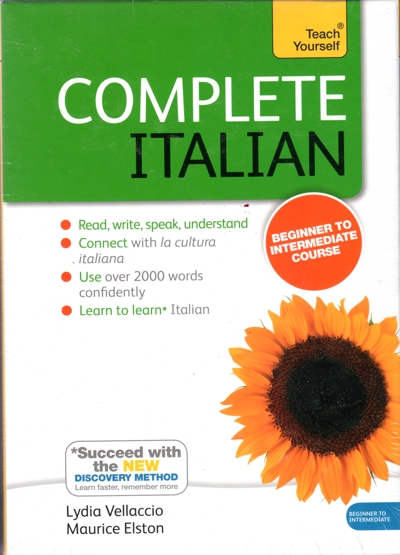
Teach Yourself Complete Italian - Learn to Speak Italian - Book and 2 Audio CDs
Brand New
: Book and 2 Audio CDs - 416 page book
Are you looking for a complete course in Italian which takes you effortlessly from beginner to confident speaker? Whether you are starting from scratch, or are just out of practice, Complete Italian will guarantee success! Now fully updated to make your language learning experience fun and interactive. You can still rely on the benefits of a top language teacher and our years of teaching experience, but now with added learning features within the course and online. The course is structured in 25 thematic units and the emphasis is placed on communication, so that you effortlessly progress from introducing yourself and dealing with everyday situations, to using the phone and talking about work.
By the end of this course, you will be at Level B2 of the Common European Framework for Languages: Can interact with a degree of fluency and spontaneity that makes regular interaction with native speakers quite possible without strain for either party. Learn effortlessly with full colour text, easy-to-read page design and interactive features:
NOT GOT MUCH TIME?
One, five and ten-minute introductions to key principles to get you started.
AUTHOR INSIGHTS
Lots of instant help with common problems and quick tips for success, based on the author's many years of experience.
GRAMMAR TIPS
Easy-to-follow building blocks to give you a clear understanding.
USEFUL VOCABULARY
Easy to find and learn, to build a solid foundation for speaking.
DIALOGUES
Read and listen to everyday dialogues to help you speak and understand fast.
PRONUNCIATION
Don’t sound like a tourist! Perfect your pronunciation before you go.
TEST YOURSELF
Tests in the book and online to keep track of your progress.
EXTEND YOUR KNOWLEDGE
Extra online articles at: www.teachyourself.com to give you a richer understanding of the culture and history of France.
TRY THIS
Innovative exercises illustrate what you’ve learnt and how to use it.
* The complete, fully interactive language learning package
* Pack contains book with new full-colour page design and fresh layout and CDs with fully downloadable audio content
* Interactive features include 1, 5 and 10 minute summaries and author tips and insights
* Clear level delineation helps learners identify an achievable target; the course encompasses levels 1 to level 4 of the Common European Framework for Languages
Table of Contents:
Introduction
01 Excuse me!
02 Out and about in town
03 What's your name?
04 How much is it?
05 The interview
06 At the station
07 At the restaurant
08 At the hotel
09 On the phone
10 Work and spare time
11 Daily necessities and preferences
12 I'm looking for accommodation
13 Everyday life
14 I'd like some information
15 What did you do today?
16 Do you like travelling?
17 So many things to do!
18 What present to give?
19 Study and work
20 How do you feel?
21 Plans: holidays, music, art
22 Then and now
23 No need to be polite!
24 Do you need any help?
25 Exchange of opinions
Taking it further
Testing yourself
Key to the exercises
Key to the tests
Glossary of grammatical terms
Italian-English vocabulary
English-Italian vocabulary
Grammar index
About the Authors Lydia Vellaccio and Maurice Elston
Lydia Vellaccio and Maurice Elston have many years’ experience of teaching Italian to English-speaking students from all sorts of social and educational backgrounds.
About the Italian Language
Italian is a Romance language spoken by about 63 million people, primarily in Italy. In Switzerland, Italian is one of four official languages. It is also the official language of San Marino and Vatican City. Standard Italian, adopted by the state after the unification of Italy, is based on Tuscan dialect and is somewhat intermediate between Italo-Dalmatian languages of the South and Northern Italian dialects of the North.
Unlike most other Romance languages, Italian has retained the contrast between short and long consonants which existed in Latin. As in most Romance languages, stress is distinctive. Of the Romance languages, Italian is considered to be one of the closest resembling Latin in terms of vocabulary, though Romanian most closely preserves the noun declension system of Classical Latin, and Spanish the verb conjugation system , while Sardinian is the most conservative in terms of phonology.
In Italy, all Romance languages spoken as the vernacular in Italy, other than standard Italian and other unrelated, non-Italian languages, are termed "Italian dialects". Many Italian dialects are, in fact, historical languages in their own right. These include recognized language groups such as Friulian, Neapolitan, Sardinian, Sicilian, Venetian, and others, and regional variants of these languages such as Calabrian. Though the division between dialect and language has been used by scholars (such as by Francesco Bruni) to distinguish between the languages that made up the Italian koine, and those which had very little or no part in it, such as Albanian, Greek, German, Ladin, and Occitan, which are still spoken by minorities.

Dialects are generally not used for general mass communication and are usually limited to native speakers in informal contexts. In the past, speaking in dialect was often deprecated as a sign of poor education. Younger generations, especially those under 35 (though it may vary in different areas), speak almost exclusively standard Italian in all situations, usually with local accents and idioms. Regional differences can be recognized by various factors: the openness of vowels, the length of the consonants, and influence of the local dialect (for example, annà replaces andare in the area of Rome for the infinitive "to go"). |

 0 Items (Empty)