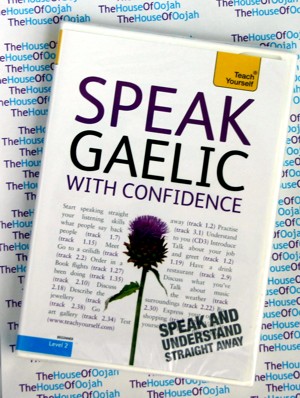
Speak Gaelic with Confidence - 3 Audio CDs and Booklet
Brand New (Booklet and 3 CDs):
Perfect for complete beginners or those who want to brush up on the language, Teach Yourself Gaelic Conversation encourages you to speak out loud from the very start. It features 10 topics that include 15 key words, three useful phrases, and one grammar point. Two sample conversations bring all those elements together correctly. There are plenty of review opportunities, so you can gauge your progress and reinforce what you have learned. In addition, the third CD provides invaluableguidance on holding two-way conversations, addressing such issues as speaking with people who talk very fast or use words and phrases you do not know.
back to top
About the Authors
Boyd Robertson and Gordon Wells are experienced teachers and developers of Gaelic language learning materials.
Table of Contents:
CD1Introduction; Meeting and Greeting; Getting Around; Basic Requests; Shopping; Sightseeing
CD2At the Restaurant; Describing People; At the Beach; What's the Matter?; Taking Your Leave
CD3Review of all above.
About the Gaelic Language
Gaelic is a member of the Goidelic branch of Celtic languages. This branch also includes the Irish and Manx languages. It is distinct from the Brythonic branch of the Celtic languages, which includes Welsh, Cornish, and Breton. Scottish, Manx and Irish Gaelic are all descended from Old Irish. The language is often described as Scottish Gaelic, Scots Gaelic, or Gàidhlig to avoid confusion with the other two Goidelic languages. Outside Scotland, it is occasionally also called Scottish, a usage dating back over 1,500 years; for example Old English Scottas. Scottish Gaelic should not be confused with Scots, because since the 16th century the word Scots has by-and-large been used to describe the Lowland Anglic language, which developed from the northern form of early Middle English. Old Gaelic, the precursor to both Modern Irish and Scottish Gaelic, was written in a carved writing called Ogham. Ogham consisted of marks made above or below a horizontal line. With the advent of Christianity in the 5th century the Latin alphabet was introduced to Ireland. The Goidelic languages have historically been part of a dialect continuum stretching from the south of Ireland, the Isle of Man, to the north of Scotland.
Classical Gaelic was used as a literary language in Ireland until the 17th century and in Scotland until the 18th century. Later orthographic divergence is the result of more recent orthographic reforms resulting in standardised pluricentric diasystems.
The 1767 New Testament historically set the standard for Scottish Gaelic. Around the time of World War II, Irish spelling was reformed and the Official Standard or Caighdeán Oifigiúil introduced. Further reform in 1957 eliminated some of the silent letters which are still used in Scottish Gaelic. The 1981 Scottish Examinations Board recommendations for Scottish Gaelic, the Gaelic Orthographic Conventions, were adopted by most publishers and agencies, although they remain controversial among some academics, most notably Ronald Black.
The modern Scottish Gaelic alphabet has 18 letters:
A, B, C, D, E, F, G, H, I, L, M, N, O, P, R, S, T, U.
The letter h, now mostly used to indicate lenition of a consonant, was in general not used in the oldest orthography, as lenition was instead indicated with a dot over the lenited consonant. The letters of the alphabet were traditionally named after trees (see Scottish Gaelic alphabet), but this custom has fallen out of use.
The quality of consonants is indicated in writing by the vowels surrounding them. So-called "slender" consonants are palatalised while "broad" consonants are velarised. The vowels e and i are classified as slender, and a, o, and u as broad. The spelling rule known as caol ri caol agus leathann ri leathann ("slender to slender and broad to broad") requires that a word-medial consonant or consonant group followed by a written i or e be also preceded by an i or e; and similarly if followed by a, o or u be also preceded by an a, o, or u. Consonant quality (palatalised or non-palatalised) is then indicated by the vowels written adjacent to a consonant, and the spelling rule gives the benefit of removing possible uncertainty about consonant quality at the expense of adding additional purely graphic vowels that may not be pronounced.
In changes promoted by the Scottish Examination Board from 1976 onwards, certain modifications were made to this rule. For example, the suffix of the past participle is always spelled -te, even after a broad consonant, as in togte "raised" (rather than the traditional togta). Where pairs of vowels occur in writing, it is sometimes unclear which vowel is to be pronounced and which vowel has been introduced to satisfy this spelling rule. Unstressed vowels omitted in speech can be omitted in informal writing. For example:
Tha mi an dòchas. ("I hope.") > Tha mi 'n dòchas.
Once Gaelic orthographic rules have been learned, the pronunciation of the written language can be seen to be quite predictable. However learners must be careful not to try to apply English sound-to-letter correspondences to written Gaelic, otherwise mispronunciations will result. Gaelic personal names such as Seònaid are especially likely to be mispronounced by English speakers. English orthographic rules have also been used at various times in Gaelic writing. Notable examples of Gaelic verse composed in this manner are the Book of the Dean of Lismore and the Fernaig manuscript. |

 0 Items (Empty)