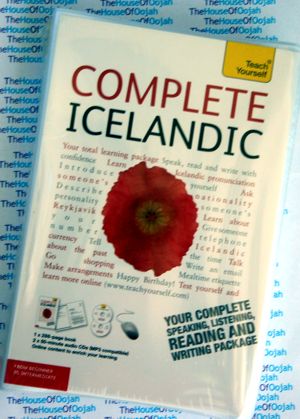
Teach Yourself Complete Icelandic - 2 Audio CDs and Book
Brand New : 2 CDs and Book
Are you looking for a complete course in Icelandic which takes you effortlessly from beginner to confident speaker? Whether you are starting from scratch, or are just out of practice, Complete Icelandic will guarantee success! Now fully updated to make your language learning experience fun and interactive. You can still rely on the benefits of a top language teacher and our years of teaching experience, but now with added learning features within the course and online.
The course is structured in thematic units and the emphasis is placed on communication, so that you effortlessly progress from introducing yourself and dealing with everyday situations, to using the phone and talking about work. By the end of this course, you will be at Level B2 of the Common European Framework for Languages: Can interact with a degree of fluency and spontaneity that makes regular interaction with native speakers quite possible without strain for either party.
Learn effortlessly with a new easy-to-read page design and interactive features:
NOT GOT MUCH TIME?
One, five and ten-minute introductions to key principles to get you started.
AUTHOR INSIGHTS
Lots of instant help with common problems and quick tips for success, based on the author's many years of experience.
GRAMMAR TIPS
Easy-to-follow building blocks to give you a clear understanding.
USEFUL VOCABULARY
Easy to find and learn, to build a solid foundation for speaking.
DIALOGUES
Read and listen to everyday dialogues to help you speak and understand fast.
PRONUNCIATION
Don’t sound like a tourist! Perfect your pronunciation before you go.
TEST YOURSELF
Tests in the book and online to keep track of your progress.
EXTEND YOUR KNOWLEDGE
Extra online articles at: www.teachyourself.com to give you a richer understanding of the culture and history of Iceland.
TRY THIS
Innovative exercises illustrate what you’ve learnt and how to use it.
* This is the only Icelandic course with accompanying listening material on CD
* Enjoyable to use - the storyline running through the book keeps new language in context
* Comprehensive - covers a wide range of topics and language structures
Table of Contents:
Pronunciation
01 Bjorn's family
02 Klaus arrives from Germany
03 Bjorn shows Klaus around Reykjavik
04 Bjorn, Klaus and their friends go to the cinema
05 Bjorn and Klaus go to visit Inga
06 Klaus and Inga buy some groceries
07 Klaus goes to the bank
08 Inga helps Klaus look for a flat
09 Bjorn, Klaus and Gudrun go to Akureyri over the weekend
10 Bjorn and Klaus buy a birthday present for Gudrun
11 Klaus starts university
Icelandic-English vocabulary
English-Icelandic vocabulary
Taking it further
About the Author
Hidur Jonsdottir is a PhD student of Linguistics and Modern Icelandic and teaches Icelandic at Cambridge University.
About the Icelandic Language
Icelandic is a North Germanic language, the language of Iceland. Its closest relatives are Faroese and certain Norwegian dialects such as Telemark dialect and Sognamål. While most West European languages have greatly reduced levels of inflection, particularly in regards to noun declension, Icelandic retains an inflectional grammar comparable to that of Latin (a member of the group of Italic languages, which shares the Indo-European roots of Germanic) or, more closely, Old Norse and Old English. The main difference between Icelandic and Latin lies in the treatment of the verb. Nouns, adjectives, pronouns and other word classes are handled in a similar way. In particular it may be mentioned that Icelandic possesses quite a few instances of oblique cases without any governing word, much like Latin.
The vast majority of Icelandic speakers live in Iceland. There are about 8,165 speakers of Icelandic living in Denmark, of whom approximately 3,000 are students. The language is also spoken by 5,655 people in the USA and by 2,385 in Canada (mostly in Gimli, Manitoba). 97% of the population of Iceland consider Icelandic their mother tongue, but in communities outside Iceland the usage of the language is declining. Extant Icelandic speakers outside Iceland represent recent emigration in almost all cases except Gimli, which was settled from the 1880s onwards. The Icelandic constitution does not mention the language as the official language of the country. Though Iceland is a member of the Nordic Council, the Council uses only Danish, Norwegian and Swedish as its working languages, though it publishes material in Icelandic . Under the Nordic Language Convention, since 1987, citizens of Iceland have the opportunity to use Icelandic when interacting with official bodies in other Nordic countries without being liable for any interpretation or translation costs. The Convention covers visits to hospitals, job centres, the police and social security offices, however the Convention is not very well known and is mostly a recommendation. The countries have committed themselves to providing services in various languages, but citizens have no absolute rights except for criminal and court matters.
The state-funded Árni Magnússon Institute for Icelandic Studies serves as a centre for preserving the medieval Icelandic manuscripts and studying the language and its literature. The Icelandic Language Council, made up of representatives of universities, the arts, journalists, teachers, and the Ministry of Culture, Science and Education, advises the authorities on language policy. The Icelandic Language Fund supports activities intended to promote the Icelandic language. Since 1995 November 16 each year, the birthday of 19th century poet Jónas Hallgrímsson is celebrated as Icelandic Language Day. |

 0 Items (Empty)