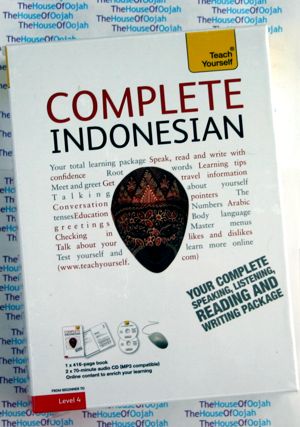
Teach Yourself Complete Indonesian 2 Audio CDs and Reference Guide - Learn to speak Indonesian
Brand New
: 1 x 416 page Book and 2 Audio CDs
Are you looking for a complete course in Indonesian (Bahasa Indonesia) which takes you effortlessly from beginner to confident speaker? Whether you are starting from scratch, or are just out of practice, Complete Indonesian (Bahasa Indonesia) will guarantee success!
Now fully updated to make your language learning experience fun and interactive. You can still rely on the benefits of a top language teacher and our years of teaching experience, but now with added learning features within the course and online.
The course is structured in thematic units and the emphasis is placed on communication, so that you effortlessly progress from introducing yourself and dealing with everyday situations, to using the phone and talking about work. By the end of this course, you will be at Level B2 of the Common European Framework for Languages: Can interact with a degree of fluency and spontaneity that makes regular interaction with native speakers quite possible without strain for either party. Learn effortlessly with a new easy-to-read page design and interactive features:
NOT GOT MUCH TIME?
One, five and ten-minute introductions to key principles to get you started.
AUTHOR INSIGHTS
Lots of instant help with common problems and quick tips for success, based on the author's many years of experience.
GRAMMAR TIPS
Easy-to-follow building blocks to give you a clear understanding.
USEFUL VOCABULARY
Easy to find and learn, to build a solid foundation for speaking.
DIALOGUES
Read and listen to everyday dialogues to help you speak and understand fast.
PRONUNCIATION
Don’t sound like a tourist! Perfect your pronunciation before you go.
TEST YOURSELF
Tests in the book and online to keep track of your progress.
EXTEND YOUR KNOWLEDGE
Extra online articles at: www.teachyourself.com to give you a richer understanding of the culture and history of Indonesia.
TRY THIS
Innovative exercises illustrate what you’ve learnt and how to use it.
* There is very little available for the person wanting to learn Indonesian. This course caters for all learners - complete beginners and those with a smattering of the language. The topics covered will appeal to those learning for holiday and business purposes.
* Covers a wide range of topics and language structures for learners who want to progress quickly beyond the basics to a level where they can communicate with confidence
* There is both an Indonesian-English and an English-Indonesian vocabulary listing
* 150-minutes worth of listening/pronunciation practice available on two CDs to accompany the course
Table of Contents:
greetings and personal introductions
getting to know people
talking about jobs and studies
family and home
at the tourist information office
discussing plans and intentions
asking the way
changing money
getting around
at the hotel
shopping
more shopping
at the restaurant
more on food
talking about hobbies and free time
talking about people
seeing a doctor
the weather and making plans
complaints and problems
signs and warnings
expressing opinions
letters and appointments
street language
grammar section
transcripts of the dialogues
key to the exercises
Indonesian-English vocabulary
English-Indonesian vocabulary

About the Authors
Christopher Byrnes is a foreign languages graduate who
went on to do a teaching qualification. He began his teaching career as a
teacher of English as a Foreign Language and continued to study other languages
while teaching all over the world.
Eva Nyimas is a native of Sumatera, Java, and
can speak several native Indonesian languages as well as standard Indonesian,
Malay and English. She has taught English and Indonesian to children and to
adults and is dedicated to the spread of Indonesian language and culture
throughout the world.
About the Indonesian Language
Indonesian (Bahasa Indonesia) is the official language of Indonesia. Indonesian is a standardized dialect of the Malay language that was officially defined with the declaration of Indonesia's independence in 1945 although in the 1928 Indonesian Youth Pledge have declared it as the official language.
Indonesia is the fourth most populous nation in the world. Of its large population the number of people who fluently speak Indonesian is fast approaching 100%, thus making Indonesian one of the most widely spoken languages in the world. Most Indonesians, aside from speaking the national language, are often fluent in another regional language or local dialect (examples include Minangkabau, Sundanese and Javanese) which are commonly used at home and within the local community. Most formal education, as well as nearly all national media and other forms of communication, are conducted in Indonesian. In East Timor, which was an Indonesian province from 1975 to 1999, the Indonesian language is recognised by the constitution as one of the two working languages (the other is English, alongside the official languages of Tetum and Portuguese).
The Indonesian name for the language is Bahasa Indonesia (lit. "the language of Indonesia"). This term can sometimes still be found in written or spoken English. In addition, the language is sometimes referred to as "Bahasa" by English-speakers, though this simply means "language" and thus is also not an official term for the Indonesian language.
To a certain degree, Indonesian can be regarded as an open language. Over the years, foreign languages such as Sanskrit, Chinese, Arabic, Portuguese, Dutch and English have influenced and expanded the Indonesian language, mostly through trade contacts and international media.
Because of its semi-open status, there are those who regard Indonesian (as well as other forms of Malay) as lacking sufficient vocabularly and specialist terminologies. Yet some linguists consider this view to be a misconception, as a vast majority of foreign adopted words do have native equivalents. For example, the word asimilasi (from the Dutch word assimilatie) can also be expressed in Indonesian as penggabungan. Many words describing more modern inventions, objects or ideas are often Indonesianised adoptions of foreign words (e.g. computer becomes komputer), although many of these words also have Indonesian equivalents. For example, a "cell/mobile phone" can be referred to in Indonesian as either pon-sel/ telepon seluler (lit. cellular-telephone), HP (pronounced hah-péh - the acronymic form of hand phone) or telepon genggam (lit. "hold-in-the-hand telephone"). Other words such as "rice cooker" may be referred to simply as "rice cooker" or, again, in a more native Indonesian/ Malay form, i.e. penanak nasi (a word formed from the verb menanak, meaning 'to cook rice by boiling' + nasi, meaning 'cooked rice'). Overall, the use of native and non-native words in Indonesian is equally common and reflects the country's efforts towards modernization and globalization.
However, Indonesian does possess a complex system of affixations. The absence of tenses in the language is substituted through the use of aspect particles and (as with any language) Indonesian grammar often presents an array of exceptions. Also, the simplicity of Indonesian grammar at a beginners or basic level has the disadvantage of misleading many learners of the language into thinking that more advanced Indonesian grammar is just as simple.
Many aspects of Indonesian grammar are relatively simple in the initial stages of study, making it one of the easiest languages to learn for adults. Indonesian does not require conjugation of verb tenses or participles, plural forms, articles and gender distinction for the third person pronouns. It is important to note that neither do many other languages traditionally regarded as 'complex', including Chinese and Thai for example. In spite of this, Indonesian and Malay are generally regarded as easy languages to learn, mostly because they are not tonal languages and they no longer use complex characters within their writing system, but rather utilize the Latin alphabet. Similar cases can also be seen in other Southeast Asian languages such as Vietnamese and Tagalog. |

 0 Items (Empty)