
 0 Items (Empty)


Learn in Your Car French
Learn in your Car French
These titles where produced by Penton until about 2009. They are no longer published.
These are some alternative French Courses with similar content to Learn in Your Car French:
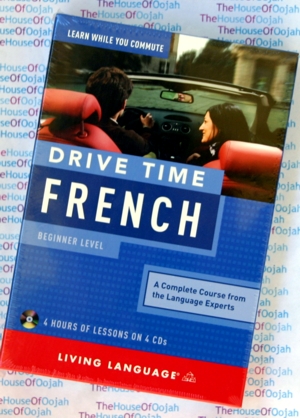
Drive Time French
|
French for Dummies
|
Michel Thomas Speak French
|
Teach Yourself Complete French
|



For the period to as much as around 1300, some linguists refer to the oïl languages collectively as Old French (ancien français). The earliest extant text in French could possibly be the Oaths of Strasbourg from 842; Old French became a literary language along with the chansons de geste that told tales associated with the paladins of Charlemagne as well as the heroes associated with the Crusades.
Simply because of the Ordinance of Villers-Cotterêts in 1539 King Francis I made French the official language of administration and court proceedings in France, ousting the Latin that was used before then. Along with the imposition of a standardised chancery dialect along with the loss of the declension system, the dialect is known as Middle French (moyen français). The first grammatical description of French, the Tretté de la Grammaire française by Louis Maigret, was published in 1550. Many 700 words of modern French that are derived from Italian were introduced in this period, including several denoting artistic concepts (scenario, piano), luxury items, and food.
After having a period of unification, regulation and purification, the French associated with the 17th in direction of the 18th centuries might possibly be referred to as Classical French (français classique), although a lot of linguists simply refer to French language coming from the 17th century to today as Modern French (français moderne).
The basement walls of the Académie française (French Academy) in 1634 by Cardinal Richelieu created the state run body whose goal could have been the purification and preservation associated with the French language. This group of 40 members is actually the Immortals, not, as some erroneously believe, as they are chosen to serve used for the extent of their lives (which they are), but the foremost problems inscription engraved found on the official seal made available to them by their founder Richelieu-"À l'immortalité" ("in the direction of Immortality (belonging to the French language)"). The building blocks still exists and plays a part in the policing associated with the language along with the adaptation of foreign words and expressions. Some recent modifications range from the change from software to logiciel, packet-boat to paquebot, and riding-coat to redingote. The idea of ordinateur for computer was however not created by the Académie, but by just a linguist appointed by IBM
Belonging to the 17th to the 19th centuries, France was the leading power of Europe; thanks to this, with influence associated with the Enlightenment, French was the lingua franca of educated Europe, especially about the arts, literature, and diplomacy; monarchs like Frederick II of Prussia and Catherine the Great of Russia could both speak and write in French.
By means of the 17th and 18th centuries, the French language established itself permanently inside of the Americas. You will find an academic debate about precisely how fluent in French were the colonists of the latest France. While a minority of colonists (mostly women) were out of the region of Paris (approximately 20% of all colonists), many got their start in northern and western regions of France where French was not that individuals choose to language natively spoken by its inhabitants. It isn't clearly known, however, what number of those types of colonists understood French as being a second language, as well as many and this includes - who, in overwhelming majority, natively spoke an oïl language - could understand, turn out to be understood by, those who speak French due to the fact interlinguistic similarity. Naturally, a linguistic unification with all the self-proclaimed groups as a result of France happened (either in France, located on the ships, or even in "Canada") in a way that, as mentioned in many sources, the then "Canadiens" were all speaking French natively in the end of the 17th century, well before the unification was complete in France. Today, French often is the language of about 10 million people (not counting French-based creoles) while in the Americas.
All over the Académie, public education, centuries of official control as well as the role of media, a unified official French language also has been forged, but there remains a lot of diversity today when considering regional accents and words. For some critics, the "best" pronunciation associated with the French language is somewhat recognized turn out to be the only one used in Touraine (around Tours and therefore the Loire River valley), but such value judgments are fraught with problems, are investigating ever increasing loss of lifelong attachments to a new specific region and then the growing importance belonging to the national media, the long run of specific "regional" accents can be frequently for you to predict. The French nation-state, which appeared as soon as the 1789 French Revolution and Napoleon's empire, unified the French people in particular through to the consolidation of the technique French language. Hence, in keeping with historian Eric Hobsbawm, "the French language has long been essential to the concept of 'France', although in 1789 50% of the French people didn't speak it from the least, in support of 12 to 13% spoke it 'fairly' - believe it or not, even in oïl language zones, as a result of a central region, all this was not usually spoken except in cities, and, even there, not always in a very faubourgs [approximatively translatable to "suburbs"]. From inside the North as in the South of France, almost nobody spoke French." Hobsbawm highlighted the role of conscription, invented by Napoleon, and of the 1880s public instruction according to the, which allowed to mix the variety of groups of France to be able to nationalist mold which created the French citizen with his fantastic consciousness of membership to a great common nation, while a variety of "patois" were progressively eradicated.


