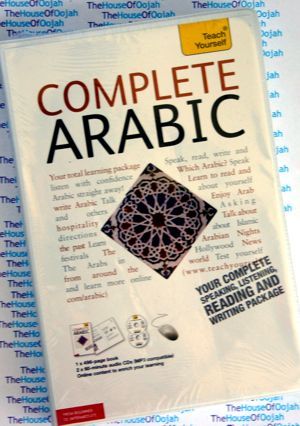
Teach Yourself Arabic - 2 Audio CDs and Book
Brand New : 2 CDs and Book
Do you want to be able to speak, read and write Modern Standard Arabic confidently? This bestselling course from Teach Yourself – the No.1 brand in language learning – teaches Modern Standard Arabic (MSA), used in writing and formal speech throughout the Arabic-speaking world to enable communication between speakers of the various regional varieties of Arabic. This new edition has complete audio support available separately - MP3 compatible.
To learn the spoken Arabic of the Gulf region, pick up a copy of Complete Spoken Arabic (of the Gulf), also from Teach Yourself.
Complete Arabic is structured in thematic units and the emphasis is placed on communication, so that you effortlessly progress from introducing yourself and dealing with everyday situations, to using the phone and talking about work.
By the end of this course, you will be at Level B2 of the Common European Framework for Languages: Can interact with a degree of fluency and spontaneity that makes regular interaction with native speakers quite possible without strain for either party.
Learn effortlessly with a new easy-to-read page design and interactive features:
NOT GOT MUCH TIME?
One, five and ten-minute introductions to key principles to get you started.
AUTHOR INSIGHTS
Lots of instant help with common problems and quick tips for success, based on the author's many years of experience.
GRAMMAR TIPS
Easy-to-follow building blocks to give you a clear understanding.
USEFUL VOCABULARY
Easy to find and learn, to build a solid foundation for speaking.
DIALOGUES
Read and listen to everyday dialogues to help you speak and understand fast.
PRONUNCIATION
Don’t sound like a tourist! Perfect your pronunciation before you go.
TEST YOURSELF
Tests in the book and online to keep track of your progress.
EXTEND YOUR KNOWLEDGE
Extra online articles at: www.teachyourself.com to give you a richer understanding of the culture and history of the Arab world
* The complete, fully interactive language learning package
* Pack contains book with new full-colour page design and fresh layout and CDs with fully downloadable audio content
* Interactive features include 1, 5 and 10 minute summaries and author tips and insights
* Clear level delineation helps learners identify an achievable target; the course encompasses levels 1 to level 4 of the Common European Framework for Languages
Table of Contents:
Introduction & How to use this course
Arabic script and pronunciation guide
Let's get started!
Personal details
How you describe yourself
This and that
Our house is your house
Where is the town centre?
What did you do?
Once upon a time
More than one
What do you do?
Islamic festivals
Woman's page
The Arabian Gulf
Hearing is obeying (The Arabian Nights)
The Arabs in Hollywood
Sports page
If God wills
News from every country
Key to the exercises
Listening transcripts
Glossary of language terms
Grammar summary
Verb tables
Arabic-English vocabulary
English-Arabic vocabulary
Grammar index
About the Author:
Before he retired, Jack Smart was Lecturer in Arabic and Islamic studies at the University of Exeter. Frances Altorfer was a modern languages' teacher for many years.
About the Arabic Language
Arabic is the largest living member of the Semitic language family in terms of speakers. Classified as Central Semitic, it is closely related to Hebrew and Aramaic, and has its roots in a Proto-Semitic common ancestor. Modern Arabic is classified as a macrolanguage with 27 sub-languages in ISO 639-3. These varieties are spoken throughout the Arab world, and Standard Arabic is widely studied and known throughout the Islamic world.
Modern Standard Arabic derives from Classical Arabic, the only surviving member of the Old North Arabian dialect group, attested epigraphically since the 6th century, which has been a literary language and the liturgical language of Islam since the 7th century. Arabic has lent many words to other languages of the Islamic world, as Latin has contributed to most European languages. And in turn, it has also borrowed from those languages, as well as Persian and Sanskrit from early contacts with their affiliated regions. During the Middle Ages, Arabic was a major vehicle of culture, especially in science, mathematics and philosophy, with the result that many European languages have also borrowed numerous words from it especially Spanish and Portuguese, countries it ruled for 700 years (see Al-Andalus).
"Colloquial Arabic" is a collective term for the spoken varieties of Arabic used throughout the Arab world, which, as mentioned, differ radically from the literary language. The main dialectal division is between the North African dialects and those of the Middle East, followed by that between sedentary dialects and the much more conservative Bedouin dialects. Speakers of some of these dialects are unable to converse with speakers of another dialect of Arabic; in particular, while Middle Easterners can generally understand one another, they often have trouble understanding North Africans (although the converse is not true, due to the popularity of Middle Eastern—especially Egyptian—films and other media).
One factor in the differentiation of the dialects is influence from the languages previously spoken in the areas, which have typically provided a significant number of new words, and have sometimes also influenced pronunciation or word order; however, a much more significant factor for most dialects is, as among Romance languages, retention (or change of meaning) of different classical forms. Thus Iraqi aku, Levantine fīh, and North African kayən all mean "there is", and all come from classical Arabic forms (yakūn, fīhi, kā'in respectively), but now sound very different.
|

 0 Items (Empty)