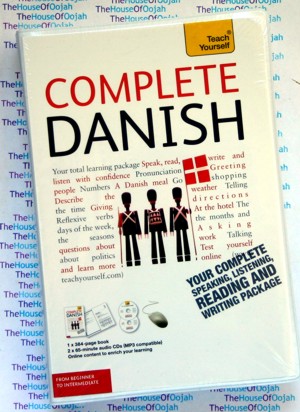
Teach Yourself Complete Danish - Book and 2 Audio CDs
2 CDs plus 384 page book
Are you looking for a complete course in Danish which takes you effortlessly from beginner to confident speaker? Whether you are starting from scratch, or are just out of practice, Complete Danish will guarantee success! Now fully updated to make your language learning experience fun and interactive. You can still rely on the benefits of a top language teacher and our years of teaching experience, but now with added learning features within the course and online.
The course is structured in thematic units and the emphasis is placed on communication, so that you effortlessly progress from introducing yourself and dealing with everyday situations, to using the phone and talking about work.
By the end of this course, you will be at Level B2 of the Common European Framework for Languages: Can interact with a degree of fluency and spontaneity that makes regular interaction with native speakers quite possible without strain for either party. This course will appeal to those who want to refresh existing knowledge as well as complete beginners who want to gain a thorough grounding in understanding, speaking and writing Danish.
Covers a wide range of topics and language structures for learners who want to progress quickly beyond the basics to a level where they can communicate with confidence.
The topics covered will appeal to those learning for holiday and business purposes. Learn effortlessly with a new easy-to-read page design and interactive features:
NOT GOT MUCH TIME?
One, five and ten-minute introductions to key principles to get you started.
AUTHOR INSIGHTS
Lots of instant help with common problems and quick tips for success, based on the author's many years of experience.
GRAMMAR TIPS
Easy-to-follow building blocks to give you a clear understanding.
USEFUL VOCABULARY
Easy to find and learn, to build a solid foundation for speaking.
DIALOGUES
Read and listen to everyday dialogues to help you speak and understand fast.
PRONUNCIATION
Don't sound like a tourist! Perfect your pronunciation before you go.
TEST YOURSELF
Tests in the book and online to keep track of your progress.
EXTEND YOUR KNOWLEDGE
Extra online articles at: www.teachyourself.com to give you a richer understanding of the culture and history of Denmark.
TRY THIS
Innovative exercises illustrate what you've learnt and how to use it.
Table of Contents:
Introduction
Pronunciation
01 At the railway station
02 It was a lovely meal!
03 Shopping
04 At the airport
05 Weekend in North Zealand
06 By train to Jutland
07 At a business meeting
08 At the hotel
09 At a cottage in Mols
10 On board the ferry
11 Back at Hans and Lone's house
12 On a language course
13 Tourists in Copenhagen
14 At a restaurant
15 When you visited us in England
16 Alison is ill
17 Shopping in Copenhagen
18 Goodbye, till next time!
Strong and irregular verbs
Glossary of grammatical terms
Key to the exercises
Danish-English vocabulary
English-Danish vocabulary
Taking it further
Index
About the Author Bente Elsworth
Bente Elsworth was born in Randers, Demark. She has lived in England since 1968 and has a degree in Russian from the University of London. She has many years of experience in teaching Danish at the University of East Anglia and this has made her aware of the particular problems that English speakers face when learning Danish. This knowledge forms the basis of the approach adopted in Teach Yourself Danish.
About the Danish Language
Danish (dansk) is one of the North Germanic languages (also called
Scandinavian languages), a sub-group of the Germanic branch of the
Indo-European languages. It is spoken by around 6 million people, mainly in
Denmark; the language is also used by the 50,000 Danes in the northern parts of
Schleswig-Holstein in Germany, where it holds the status of minority language.
Danish also holds official status and is a mandatory subject in school in the
Danish territories of Greenland and the Faroe Islands, which now enjoy limited
autonomy. In Iceland and Faroe Islands, Danish is, alongside English, a
compulsory foreign language taught in schools (although it may be substituted
by Swedish or Norwegian). In North and South America there are Danish language
communities in Argentina, the USA and Canada.
In the 8th century, the common Germanic language of Scandinavia, Proto-Norse,
had undergone some changes and evolved into Old Norse. This language began to
undergo new changes that did not spread to all of Scandinavia, which resulted
in the appearance of two similar dialects, Old West Norse (Norway and Iceland)
and Old East Norse (Denmark and Sweden).
Old East Norse is in Sweden called Runic Swedish and in east Denmark Runic
Danish, but until the 12th century, the dialect was roughly the same in the two
countries. The dialects are called runic due to the fact that the main body of
text appears in the runic alphabet. Unlike Proto-Norse, which was written with
the Elder Futhark alphabet, Old Norse was written with the Younger Futhark
alphabet, which only had 16 letters. Due to the limited number of runes, some
runes were used for a range of phonemes, such as the rune for the vowel u which
was also used for the vowels o, ø and y, and the rune for i which was also used
for e.
A change that separated Old East Norse (Runic Swedish/Danish) from Old West
Norse was the change of the diphthong æi (Old West Norse ei) to the monophthong
e, as in stæin to sten. This is reflected in runic inscriptions where the older
read stain and the later stin. There was also a change of au as in dauðr into ø
as in døðr. This change is shown in runic inscriptions as a change from tauþr
into tuþr. Moreover, the øy (Old West Norse ey) diphthong changed into ø as
well, as in the Old Norse word for "island".
Some famous authors of works in Danish are existential philosopher Søren
Kierkegaard, prolific fairy tale author Hans Christian Andersen, and playwright
Ludvig Holberg. Three 20th century Danish authors have become Nobel Prize
laureates in Literature: Karl Adolph Gjellerup and Henrik Pontoppidan (joint
recipients in 1917) and Johannes Vilhelm Jensen (awarded 1944).
Danish was once widely spoken in the northeast counties of England. Many Danish
derived words such as gate (gade) for street, still survive in Yorkshire and
other parts of eastern England colonized by Danish Vikings. The city of York
was once the Danish settlement of Jorvik.
The first printed book in Danish dates from 1495. The first complete
translation of the Bible in Danish was published in 1550.
Danish is the national language of Denmark, one of two official languages of
Greenland (the other is Greenlandic), and one of two official languages of the
Faroes (the other is Faroese). In addition, there is a small community of
Danish speakers in Schleswig, the portion of Germany bordering Denmark, where
it is an officially recognized regional language, just as German is north of
the border. Furthermore, Danish is one of the official languages of the
European Union and one of the working languages of the Nordic Council. Under
the Nordic Language Convention, citizens of the Nordic countries speaking
Danish have the opportunity to use their native language when interacting with
official bodies in other Nordic countries without being liable to any
interpretation or translation costs.
There is no law stipulating an official language for Denmark, making Danish the
de facto language only. The Code of Civil Procedure does, however, lay down
Danish as the language of the courts. Since 1997 public authorities have been
obliged to observe the official spelling by way of the Orthography Law. |

 0 Items (Empty)