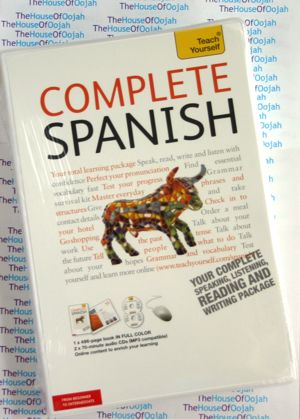
Teach Yourself Complete Spanish - Book and 2 Audio CDs
Brand New - 2 CDs and 496 page Book
Are you looking for a complete course in Spanish which takes you effortlessly from beginner to confident speaker? Whether you are starting from scratch, or are just out of practice, Complete Spanish will guarantee success!
Now fully updated to make your language learning experience fun and interactive. You can still rely on the benefits of a top language teacher and our years of teaching experience, but now with added learning features within the course and online. The course is structured in 25 thematic units and the emphasis is placed on communication, so that you effortlessly progress from introducing yourself and dealing with everyday situations, to using the phone and talking about work. By the end of this course, you will be at Level B2 of the Common European Framework for Languages: Can interact with a degree of fluency and spontaneity that makes regular interaction with native speakers quite possible without strain for either party. Learn effortlessly with full colour text, easy-to-read page design and interactive features:
NOT GOT MUCH TIME?
One, five and ten-minute introductions to key principles to get you started.
AUTHOR INSIGHTS
Lots of instant help with common problems and quick tips for success, based on the author's many years of experience.
GRAMMAR TIPS
Easy-to-follow building blocks to give you a clear understanding.
USEFUL VOCABULARY
Easy to find and learn, to build a solid foundation for speaking.
DIALOGUES
Read and listen to everyday dialogues to help you speak and understand fast.
PRONUNCIATION
Don’t sound like a tourist! Perfect your pronunciation before you go.
TEST YOURSELF
Tests in the book and online to keep track of your progress.
EXTEND YOUR KNOWLEDGE
Extra online articles at: www.teachyourself.com to give you a richer understanding of the culture and history of Spain.
TRY THIS
Innovative exercises illustrate what you’ve learnt and how to use it.
* Pack contains book with new full-colour page design and fresh layout and CDs with fully downloadable audio content
* Interactive features include 1, 5 and 10 minute summaries and author tips and insights
* Clear level delineation helps learners identify an achievable target; the course encompasses levels 1 to level 4 of the Common European Framework for Languages
Table of Contents:
Introduction
Before you start
01 I speak Spanish
02 How are you?
03 I want a room, please
04 Where is it?
05 What are you going to have?
06 What time does it arrive?
07 How much do they cost?
08 I'd like to change some money
09 How old are you?
10 What do you do?
11 I start at nine
12 I like it
13 What are you going to do?
14 Hello?
15 It was a great journey
16 Where were you born?
17 It was very small
18 What were you doing there?
19 It has been a mistake
20 We will go to the beach
21 I'd love to
22 Shall I give you some more?
23 Go straight on
24 I have a headache
25 What kind of person are you looking for?
Taking it further
Testing yourself
Glossary of grammatical terms
Grammar summary
Irregular verbs
Listening comprehension transcripts
Key to the activities
Key to 'testing yourself'
Spanish-English vocabulary
English-Spanish vocabulary
Index to grammar
Introduction
Before you start
01 I speak Spanish
02 How are you?
03 I want a room, please
04 Where is it?
05 What are you going to have?
06 What time does it arrive?
07 How much do they cost?
08 I'd like to change some money
09 How old are you?
10 What do you do?
11 I start at nine
12 I like it
13 What are you going to do?
14 Hello?
15 It was a great journey
16 Where were you born?
17 It was very small
18 What were you doing there?
19 It has been a mistake
20 We will go to the beach
21 I'd love to
22 Shall I give you some more?
23 Go straight on
24 I have a headache
25 What kind of person are you looking for?
Taking it further
Testing yourself
Glossary of grammatical terms
Grammar summary
Irregular verbs
Listening comprehension transcripts
Key to the activities
Key to 'testing yourself'
Spanish-English vocabulary
English-Spanish vocabulary
Index to grammar
About the Author:
Juan Kattan-Ibarra was born in Chile and lived in Spain for a number of years. He has degrees in foreign language teaching from the University of Chile, Michigan State University, Manchester University and the Institute of Education, London University. He taught Spanish at Ealing College and Shell International, and was an examiner in Spanish for the London Chamber of Commerce and Industry and the University of London School Examinations Board. He is now a full-time author.
About the Spanish Language
Spanish or Castilian (castellano) is an Indo-European, Romance language that originated in northern Spain, and gradually spread in the Kingdom of Castile and evolved into the principal language of government and trade. It was taken to Africa, the Americas, and Asia Pacific with the expansion of the Spanish Empire between the fifteenth and nineteenth centuries.
Today, between 322 and 400 million people speak Spanish as a native language, making it the world's second or third most-spoken language by native speakers, depending on the sources.
Spaniards tend to call this language español (Spanish) when contrasting it with languages of other states, such as French and English, but call it castellano (Castilian), that is, the language of the Castile region, when contrasting it with other languages spoken in Spain such as Galician, Basque, and Catalan. This reasoning also holds true for the language's preferred name in some Hispanic American countries. In this manner, the Spanish Constitution of 1978 uses the term castellano to define the official language of the whole Spanish State, as opposed to las demás lenguas españolas (lit. the other Spanish languages). Article III reads as follows:
The name Castellano (Castilian), which refers directly to the origins of the Language and the sociopolitical context in which it was introduced in the Americas, is preferred in Argentina, Paraguay, Peru, Uruguay and Chile, instead of español, which is more commonly used to refer to the language as a whole in the rest of Latin America.
Some Spanish speakers consider castellano a generic term with no political or ideological links, much as "Spanish" is in English.
Spanish is one of the official languages of the European Union, the Organization of American States, the Organization of Ibero-American States, the United Nations, and the Union of South American Nations. It is estimated that the combined total of native and non-native Spanish speakers is approximately 500 million, likely making it the third most spoken language by total number of speakers (after English and Chinese).
Today, Spanish is an official language of Spain, most Latin American countries, and Equatorial Guinea; 20 nations speak it as their primary language. Spanish also is one of six official languages of the United Nations. Mexico has the world's largest Spanish-speaking population, and Spanish is the second most-widely spoken language in the United States and the most popular studied foreign language in U.S. schools and universities. Global internet usage statistics for 2007 show Spanish as the third most commonly used language on the Internet, after English and Chinese.
Most Spanish speakers are in Latin America; of all countries with majority Spanish speakers, only Spain is outside of the Americas. Mexico has the most native speakers of any country. Nationally, Spanish is the official language of Argentina, Bolivia (co-official Quechua and Aymara), Chile, Colombia, Costa Rica, Cuba, Dominican Republic, Ecuador, El Salvador, Guatemala, Honduras, Mexico , Nicaragua, Panama, Paraguay (co-official Guarani), Peru (co-official Quechua and, in some regions, Aymara), Uruguay, and Venezuela. Spanish is also the official language (co-official with English) in the U.S. commonwealth of Puerto Rico.
Spanish has no official recognition in the former British colony of Belize; however, per the 2000 census, it is spoken by 43% of the population. Mainly, it is spoken by Hispanic descendants who remained in the region since the 17th century; however, English is the official language.
Spain colonized Trinidad and Tobago first in 1498, leaving the Carib people the Spanish language. Also the Cocoa Panyols, laborers from Venezuela, took their culture and language with them; they are accredited with the music of "Parang" ("Parranda") on the island. Because of Trinidad's location on the South American coast, the country is much influenced by its Spanish-speaking neighbors. A recent census shows that more than 1,500 inhabitants speak Spanish. In 2004, the government launched the Spanish as a First Foreign Language (SAFFL) initiative in March 2005. Government regulations require Spanish to be taught, beginning in primary school, while thirty percent of public employees are to be linguistically competent within five years. The government also announced that Spanish will be the country's second official language by 2020, beside English.
Spanish is important in Brazil because of its proximity to and increased trade with its Spanish-speaking neighbors; for example, as a member of the Mercosur trading bloc. In 2005, the National Congress of Brazil approved a bill, signed into law by the President, making Spanish available as a foreign language in secondary schools. In many border towns and villages (especially on the Uruguayan-Brazilian border), a mixed language known as Portuñol is spoken.
In the 2006 census, 44.3 million people of the U.S. population were Hispanic or Latino by origin; 34 million people, 12.2 percent, of the population older than 5 years speak Spanish at home. Spanish has a long history in the United States (many south-western states were part of Mexico and Spain), and it recently has been revitalized by much illegal immigration from Latin America. Spanish is the most widely taught foreign language in the country. Although the United States has no formally designated "official languages," Spanish is formally recognized at the state level in various states besides English; in the U.S. state of New Mexico for instance, 30% of the population speaks the language. It also has strong influence in metropolitan areas such as Los Angeles, Miami, San Antonio, New York City, and in the 2000s the language has rapidly expanded in Atlanta, Houston, Phoenix and other major Sun-Belt cities. Spanish is the dominant spoken language in Puerto Rico, a U.S. territory. In total, the U.S. has the world's fifth-largest Spanish-speaking population.
There are important variations among the regions of Spain and throughout Spanish-speaking America. In some countries in Hispanophone America, it is preferable to use the word castellano to distinguish their version of the language from that of Spain, thus asserting their autonomy and national identity. In Spain, the Castilian dialect's pronunciation is commonly regarded as the national standard, although a use of slightly different pronouns called laísmo of this dialect is deprecated. More accurately, for nearly everyone in Spain, "standard Spanish" means, "pronouncing everything exactly as it is written," an ideal which does not correspond to any real dialect, though the northern dialects are the closest to it. In practice, the standard way of speaking Spanish in the media is "written Spanish" for formal speech, "Madrid dialect" (one of the transitional variants between Castilian and Andalusian) for informal speech.
Spanish evolved from Vulgar Latin, with major influences from Arabic in vocabulary during the Andalusian period and minor surviving influences from Basque and Celtiberian, as well as Germanic languages via the Visigoths. Spanish developed along the remote cross road strips among the Alava, Cantabria, Burgos, Soria and La Rioja provinces of Northern Spain (see Glosas Emilianenses), as a strongly innovative and differing variant from its nearest cousin, Leonese, with a higher degree of Basque influence in these regions (see Iberian Romance languages). Typical features of Spanish diachronical phonology include lenition (Latin vita, Spanish vida), palatalization (Latin annum, Spanish año, and Latin anellum, Spanish anillo) and diphthongation (stem-changing) of short e and o from Vulgar Latin (Latin terra, Spanish tierra; Latin novus, Spanish nuevo). Similar phenomena can be found in other Romance languages as well.
During the Reconquista, this northern dialect from Cantabria was carried south, and remains a minority language in the northern coastal Morocco.
The first Latin-to-Spanish grammar (Gramática de la Lengua Castellana) was written in Salamanca, Spain, in 1492, by Elio Antonio de Nebrija. When it was presented to Isabel de Castilla, she asked, "What do I want a work like this for, if I already know the language?", to which he replied, "Your highness, the language is the instrument of the Empire."
From the 16th century onwards, the language was taken to the Americas and the Spanish East Indies via Spanish colonization.
In the 20th century, Spanish was introduced to Equatorial Guinea and the Western Sahara, and in areas of the United States that had not been part of the Spanish Empire, such as in Spanish Harlem, in New York City. For details on borrowed words and other external influences upon Spanish, see Influences on the Spanish language.
Spanish is closely related to the other West Iberian Romance languages: Asturian, Galician, Ladino, Leonese and Portuguese. Catalan, an East Iberian language which exhibits many Gallo-Romance traits, is more similar to the neighboring Occitan language than to Spanish, or indeed than Spanish and Portuguese are to each other.
Spanish and Portuguese share similar grammars and vocabulary as well as a common history of Arabic influence while a great part of the peninsula was under Islamic rule (both languages expanded over Islamic territories). Their lexical similarity has been estimated as 89%.
|

 0 Items (Empty)