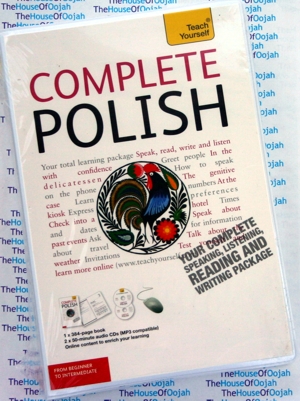
Teach Yourself Complete Polish - 2 Audio CDs and Book
*learn how to speak, understand and write Polish
*progress quickly beyond the basics
*explore the language in depth
Now fully updated which will make your language learning experience fun and interactive. You could potentially still rely on may enhance the a top language teacher and our several years of teaching experience, the good news is with added learning features within the course and online.
The course is structured in thematic units and also the emphasis is placed on communication, in order that you effortlessly progress from introducing yourself and dealing with everyday situations, to using the phone and talking about work.
Right at the end of the particular course, you're going to be at Level B2 belonging to the Common European Framework for Languages: Can get connected to a a higher level fluency and spontaneity that makes regular interaction with native speakers quite possible without strain for either party.
Learn effortlessly with easy-to-read page design and interactive features:
NOT GOT MUCH TIME?
One, five and ten-minute introductions to key principles to obtain started.
AUTHOR INSIGHTS
Quite a few instant help with difficulties product makers and quick points to consider success, according to the author's years of experience.
GRAMMAR TIPS
Easy-to-follow building blocks to provide a clear understanding.
USEFUL VOCABULARY
Readily accessible and learn, to set up a solid foundation for speaking.
DIALOGUES
Read and listen to everyday dialogues that will help you speak and understand fast.
PRONUNCIATION
Don't could be seen as a tourist! Perfect your pronunciation prior to a go.
TEST YOURSELF
Tests ever invented and online to hold on to track of how well you're progressing.
MAKE IT HAPPEN
Innovative exercises illustrate what you've learnt and the way to use it.
Level - suitable for both the complete beginner and the person who wants to brush up existing knowledge
New features - this edition has an English-Polish vocabulary, a 'Taking it further' section with other sources of Polish, and has been reset in a new, modern page design-
Comprehensive - gives you all you need to understand and speak basic, everyday Polish
Table of Contents:
Introduction
Pronunciation
I’m on holiday
Pleased to meet you
My number is…
Sally goes sightseeing
We buy some food
I prefer to swim
At the bank and the post office
I’ve a room reserved
We make a date
Family
A lot will depend on the weather
Have you been to the doctor’s?
Do you come here often?
It suits you
All the best!
I’ve got a problem
I don’t know if I’ll have time
How did it happen?
I’ve got to go
Did you like it in Poland
Key to the exercises
Polish-English vocabulary
English-Polish vocabulary
Glossary of grammatical terms
Grammar appendix
Taking it further
Index
About the Authors:
Nigel Gotteri has recently retired from Sheffield University, where he taught Polish as a Senior Lecturer in Russian and Slavonic Studies from 1973. Joanna Michalak-Gray is an experienced tutor of Polish to adult language learners.
About the Polish Language
Polish, the state run language of Poland, comes with the largest number of speakers associated with a West Slavic language. Polish is spoken inside of a uniform manner through the majority of Poland, and has now a regular orthography. This particular language developed indigenously and retains many ancient Slavic top features of pronunciation and grammar. Although the Polish language was suppressed by occupying powers during some historical periods, a rich literature has nonetheless developed over the centuries, and quite a few works by Polish authors can be bought in translations in English along with other languages.
Polish is mainly spoken in Poland. Poland is among the most homogeneous European countries regarding its mother tongue; nearly 97% of Poland's citizens declare Polish his or her mother tongue, due to Wwii, after which you can Poland was forced to change its borders, which resulted in various migrations (German expulsions, Operation Wisła). Wedding and reception World War Ii the previously Polish territories annexed next to the USSR retained a many the Polish population that led to unwilling or unable to migrate toward the post-1945 Poland, and sometimes even today ethnic Poles constitute large minorities in Lithuania, Belarus, and Ukraine. Polish is in no way almost certainly the most widely used minority language in Lithuania's Vilnius County (26% belonging to the population, depending on 2001 census results), along with being also present in other counties. In Ukraine, Polish is frequently used inside of the Lviv and Lutsk regions. Western Belarus comes with a important Polish minority, especially from inside the Brest and Grodno regions. Identify significant numbers of Polish speakers in Argentina, Andorra, Australia, Austria, Azerbaijan, Belarus, Belgium, Brazil, Bulgaria, Canada, Czech Republic, Denmark, Estonia, Faroe Islands, Finland, France, Germany, Greece, Hungary, Israel, Iceland, Ireland, Italy, Kazakhstan, Latvia, Lebanon, Luxembourg, Mexico, The Netherlands, New Zealand, Norway, South Africa, Sweden, Peru, Romania, Russia, Serbia, Slovakia, Spain, Ukraine, UAE, the UK, Uruguay along with the United States Of America. Across the nation, Polish Americans number to a higher degree 11 million but classy cannot speak Polish fluently. In accordance with the United States Of America 2000 Census, 667,414 Americans of age 5 as well as over reported Polish as the language spoken inside the home, which is certainly about 1.4% of people which speak languages other than English or 0.25% belonging to the U.S. population. The actual biggest concentrations of Polish speakers reported in the census (over 50%) were found in three states: Illinois (185,749), New York (111,740) and New Jersey (74,663). In Canada, you will find there's signifcant Polish Canadian population and you possibly can find 242,885 speakers of Polish in accordance with the most recent census in 2006 by way of a particular concentration involved in the city of Toronto, Ontario (91,810 speakers).
The Polish language became a lot more homogeneous included in the second one half of the 20th century, in part a result of the mass migration of into the millions Polish citizens coming from the eastern in direction of western the main country following on from the east was annexed due to the fact Soviet Union in 1939, during World War 2. "Standard" Polish is still spoken somewhat differently in a variety of regions of the us, even so the differences between these broad "dialects" are slight. There certainly is never any difficulty in mutual understanding, and non-native speakers are by and large unable to tell apart among them easily. The differences are slight when you compare different dialects of English, with regard to. The regional differences correspond mainly to old tribal divisions anywhere from around a thousand years ago; the most important of there are lots of apropos numbers of speakers are Great Polish (spoken on the inside west), Lesser Polish (spoken while in the south and southeast), Mazovian (Mazur) spoken all through the central and eastern areas, and Silesian spoken while in the southwest. Mazovian shares some features with all the Kashubian language (see below). The regional differences correspond mainly to old tribal divisions anywhere from around a thousand years ago; the most important of these with regard to numbers of speakers are Greater Polish (spoken included in the west), Lesser Polish (spoken south and southeast), Mazovian (Mazur) spoken during the entire central and eastern climates, and Silesian language in to the southwest. Mazovian shares some features because of the Kashubian language (see below). Several speeches were often classified as dialects associated with the Polish language previously, while nowadays they might be with greater regularity described as separate languages. Many of the true to Kashubian language, which until recently was considered a local variety of Polish language. Some authors active in the 19th century (Shtritter, Linde, Wisniewski), preceding the works of Karskiy, suggested the Belarusian language, whether on the inside 19th century form or perhaps in the Medieval literary form, to generally be the dialect of Polish language. The concepts of Belarusian language not as being a linguistical entity on its own as well as Belarusians not to be a nation, were doing work in times during the the 1919-1920 Polish-Soviet war and, later, involved in the national policies belonging to the Second Rzeczpospolita. Finally, some modern scholars argue and see if the Silesian language is there to fact a separate speech. On the inside Polish census of 2002 over 56,000 people declared Silesian as their native language. |

 0 Items (Empty)