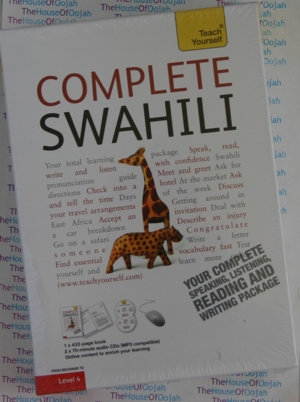
Teach Yourself Complete Swahili - 2 Audio CDs and Book
2 CDs and Book
Are you looking for a complete course in Swahili which takes you effortlessly from beginner to confident speaker? Whether you are starting from scratch, or are just out of practice, Complete Swahili will guarantee success! Now fully updated to make your language learning experience fun and interactive. You can still rely on the benefits of a top language teacher and our years of teaching experience, but now with added learning features within the course and online.
The course is structured in thematic units and the emphasis is placed on communication, so that you effortlessly progress from introducing yourself and dealing with everyday situations, to using the phone and talking about work. By the end of this course, you will be at Level B2 of the Common European Framework for Languages: Can interact with a degree of fluency and spontaneity that makes regular interaction with native speakers quite possible without strain for either party.
Learn effortlessly with a new easy-to-read page design and interactive features:
NOT GOT MUCH TIME?
One, five and ten-minute introductions to key principles to get you started.
AUTHOR INSIGHTS
Lots of instant help with common problems and quick tips for success, based on the author's many years of experience.
GRAMMAR TIPS
Easy-to-follow building blocks to give you a clear understanding.
USEFUL VOCABULARY
Easy to find and learn, to build a solid foundation for speaking.
DIALOGUES
Read and listen to everyday dialogues to help you speak and understand fast.
PRONUNCIATION
Don’t sound like a tourist! Perfect your pronunciation before you go.
TEST YOURSELF
Tests in the book and online to keep track of your progress.
EXTEND YOUR KNOWLEDGE
Extra online articles at: www.teachyourself.com to give you a richer understanding of the culture and history of Swahili speakers.
TRY THIS
Innovative exercises illustrate what you’ve learnt and how to use it.
* This course is equally suitable for the complete beginner or the person with some knowledge of Swahili who is looking for a thorough grounding in understanding, speaking and writing Swahili. The topics covered will appeal to those learning for holiday and business purposes.
* There is very little available for the person wanting to learn Swahili. This course caters for all learners - complete beginners and those with a smattering of the language.
* Covers a wide range of topics and language structures for learners who want to progress quickly beyond the basics to a level where they can communicate with confidence.
* There is both a Swahili-English and an English-Swahili vocabulary listing.
* This edition incorporates the latest language learning and teaching techniques.
Table of Contents:
Hujambo? How are you?
Kwenda Posta - Going to the Post Office
Hotelini - In the hotel
Sokoni - At the market
Kwenya Duka la Sanaa - At the craft shop
Matembezi Jioni - An evening walk
Kupika kwa Mama Mzee - Cooking at grandmother's
Kusafiri ni Kuzuri! Travelling is good!
Safari ya Basi - A bus journey
Chumba Kizuri! A good room!
Mialiko - Invitations
Hairuhusiwi Kuegesha! No parking!
Kujufunza Lugha - Learning a Language
Siku ya Taabu - A day of troubles
Katika Mbuga ya Wanyama - In the game park
Mlimani: Kuna Nini? On the moutain: what's the matter?
Mchezaji Soka na Wachezaji Ngoma - A soccer player and some dancers
Barua Zimewasili! Some letters have arrived!
Swahili-English vocabulary
English-Swahili vocabulary
About the Author Joan Russell
:
Joan Russell was born in London and taught there for a few years before leaving for Tanzania, where she taught in various institutions over the next seven years, at the same time acquiring the basics of Swahili. Her interest in the language continued during a two-year attachment to the Curriculum Development and Research Centre in Nairobi. On her return from Kenya she completed a degree in Language and Linguistics at the University of York and stayed on there to carry out sociolinguistic research on Swahili and its functions. This entailed regular extended visits to eastern Africa. She became Senior Lecturer in linguistics and African studies at the University of York.
About the Language
Swahili (called Kiswahili in the language itself) is the first language of the Swahili people (Waswahili), who inhabit several large stretches of the Indian Ocean coastline from Kenya to northern Mozambique, including the Comoros Islands. Although only 5-10 million people speak it as their native language, Swahili is a lingua franca of much of East Africa and the Democratic Republic of the Congo, is a national or official language of four nations, and is the only language of African origin among the official working languages of the African Union.
Swahili is a Bantu language that serves as the native tongue of various groups traditionally inhabiting about 1,500 miles of the Southeast African coastline. About 35% of the Swahili vocabulary derives from the Arabic language, resulting from its evolution through centuries of contact between Arabic-speaking traders and many different Bantu-speaking peoples inhabiting Africa's Indian Ocean coast. It also has incorporated Persian, German, Portuguese, Indian, and English words into its vocabulary due to contact with these different groups of people. Swahili has become a second language spoken by tens of millions in three countries, Tanzania, Kenya, and Congo (DRC), where it is an official or national language. The neighboring nation of Uganda made Swahili a required subject in primary schools in 1992�although this mandate has not been well implemented�and declared it an official language in 2005 in preparation for the East African Federation. Swahili, or other closely related languages, is spoken by nearly the entire population of the Comoros and by relatively small numbers of people in Burundi, Rwanda, Mozambique, Zambia, and Somalia.
In the Guthrie non-genetic classification of Bantu languages, Swahili is included under Bantoid/Southern/Narrow Bantu/Central/G.
At the present time, some 90 percent of approximately 39 million Tanzanians speak Swahili. Kenya's population is comparable, but the prevalence of Swahili is lower, though still widespread. Most educated Kenyans are able to communicate fluently in Swahili, since it is a compulsory subject in school from grade one. The five eastern provinces of the Democratic Republic of Congo (to be subdivided in 2009) are Swahili speaking. Nearly half the 66 million Congolese speak it; and it is starting to rival Lingala as the most important national language of that country. In Uganda, the Baganda generally don't speak Swahili, but it is in common use among the 25 million people elsewhere in the country, and is currently being implemented in schools nationwide in preparation for the East African Community. The usage of Swahili in other countries is commonly overstated, being common only in market towns, among returning refugees, or near the borders of Kenya and Tanzania. Even so, Swahili possibly exceeds Hausa of West Africa as the sub-Saharan indigenous language with the greatest number of speakers, and Swahili speakers may number some ten to fifteen percent of the 750 million people of sub-Saharan Africa (2005 World Bank Data).
Many of the world's institutions have responded to Swahili's growing prominence. It is one of the languages that feature in world radio stations such as The BBC, the Voice of America (USA), Radio Deutsche Welle (Germany), Radio Moscow International (Russia), Radio China International, Radio Sudan, and Radio South Africa.
One of the earliest known documents in Swahili is an epic poem in the Arabic script titled Utendi wa Tambuka ("The History of Tambuka"); it is dated 1728. The Latin alphabet has since become standard under the influence of European colonial powers.Methali (e.g."�Haraka haraka haina baraka - Hurry hurry has no blessing"".), i.e. �wordplay, risqué or suggestive puns and lyric rhyme, are deeply inscribed in Swahili culture, in form of Swahili parables, proverbs, and allegory�.[4] Methali is uncovered globally within �Swah� rap music. It provides the music with rich cultural, historical, and local textures and insight.
|

 0 Items (Empty)